Tuesday, August 21, 2018

IV Nobility in a Christian Society The Perennial Character of Its Mission and Its Prestige in the Contemporary World
IV Nobility in a Christian Society The Perennial Character of Its Mission and Its Prestige in the Contemporary World

IV Nobility in a Christian Society The Perennial Character of Its Mission and Its Prestige in the Contemporary World


1. Clergy, Nobility, and People

In the Middle Ages, society consisted of three classes, the clergy, the nobility, and the people, each of which had special duties, privileges, and honors.

Besides this tripartite division, a clear distinction existed between rulers and those ruled, a distinction inherent to every social group and principally to a country. Not only the king, however, but also the clergy, the nobility, and the people participated in the country's government, each one in its own way and measure.

As is well known, both Church and State constitute perfect societies, each distinct from the other and sovereign in its respective field, that is, the Church in the spiritual realm and the State in the temporal. Nonetheless, this distinction does not prevent the clergy from participating in the government of the State. In order to clarify this point, it is fitting to recall in a few words the specifically spiritual and religious mission of the clergy.

From the spiritual point of view, the clergy is the ensemble of people in the Church who have the mission to teach, govern, and sanctify, while it is for the faithful to be taught, governed, and sanctified. Such is the hierarchical order of the Church. The documents of the Magisterium establishing this distinction between the teaching Church and the learning Church are numerous. For example, Saint Pius X affirms in his encyclical Vehementer nos:

"Scripture teaches us, and the tradition of the Fathers confirms the teaching, that the Church is the Mystical Body of Christ, ruled by the Pastors and Doctors—a society of men containing within its own fold chiefs who have full and perfect powers for ruling, teaching and judging. It follows that the Church is essentially an unequal society, that is, a society comprising two categories of persons, the pastors and the flock, those who occupy a rank in the different degrees of the hierarchy and the multitude of the faithful. So distinct are these categories that with the pastoral body only rests the right and authority for promoting the end of the society and directing all its members toward that end; the one duty of the multitude is to allow themselves to be led, and, like a docile flock, to follow the pastors".35

This distinction between hierarchy and faithful in the Church, between rulers and those ruled, is also affirmed in more than one document of the Second Vatican Council.

"Therefore, by divine condescension the laity have Christ for their brother…. They also have for their brothers those in the sacred ministry who, by teaching, by sanctifying, and by ruling with the authority of Christ so feed the family of God" (Lumen Gentium, 32).

"With ready Christian obedience, laymen as well as all disciples of Christ should accept whatever their sacred pastors, as representatives of Christ, decree in their role as teachers and rulers in the Church (Lumen Gentium, 37).

"The individual bishops, to each of whom the care of a particular church has been entrusted, are, under the authority of the Supreme Pontiff, the proper, ordinary and immediate pastors of these churches. They feed their sheep in the name of the Lord, and exercise in their regard the office of teaching, sanctifying, and governing (Christus Dominus, 11).36

Through the exercise of the sacred ministry, the clergy bears the lofty and specifically religious mission of providing for the salvation and sanctification of souls. This mission produces a supremely beneficial effect on temporal society, as it always has and always will until the end of time, since sanctifying souls amounts to imbuing them with the principles of Christian morals and guiding them in the observance of the Law of God. Peoples receptive to this influence of the Church are ipso facto ideally disposed to direct all their temporal activities to the attainment of a high degree of competence, efficacy, and prosperity.

Saint Augustine's famous image of a society whose members are all good Catholics speaks for itself.

Therefore, let those who say that the teaching of Christ is contrary to the State provide such an army as the teaching of Christ orders soldiers to be; let them provide such governors, such husbands, such wives, such parents, such children, such masters, such servants, such kings, such judges, and lastly such taxpayers and tax collectors as Christian teaching admonishes them to be; and then let them dare to say that this teaching is opposed to the welfare of the State, or, rather, let them even hesitate to admit that it is the greatest safeguard of the State when faithfully observed37

Under this perspective, it is proper for the clergy to firmly establish and maintain the moral foundations of the perfect civilization, the Christian one. By a natural connection, in the Middle Ages, education and works of public assistance and charity were entrusted to the Church. The Church performed these services, normally the purview of the departments of education and public health in contemporary secular states, without burden to the public coffers.

It is understandable then that the clergy was recognized as the first class in the Middle Ages, due to the supernatural and sacred character of its spiritual mission, and also to the beneficial effects its proper exercise produced in temporal society.

On the other hand, the clergy, in the exercise of its sublime mission, apart from any temporal or terrestrial power, is an active factor in the formation of the nation's spirit and mentality. Between clergy and nation, there normally exists an exchange of understanding, trust, and affection that apportions to the former unmatched possibilities to know and orient the aspirations, concerns, sufferings, in short, the spiritual life of the population, as well as the temporal affairs that are inseparable from it. To accord the clergy a voice and a vote in the great and decisive national assemblies is, therefore, an invaluable way for the State to ascertain the yearnings of its people.

Hence it is understandable that throughout history clerics, although maintaining their alterity in relation to the political life of the country, have frequently been heeded and respected counselors of the public power and valuable participants in the development of certain legislative matters and governmental policies.

But the picture of relations between the clergy and the public power is not limited to this.

The clergy is not a group of angels living in Heaven, but of men who exist and act concretely on this earth as God's ministers. The clergy comprises part of the country's population, before which its members have specific rights and duties. The protection of these rights and the proper fulfillment of these duties are of utmost importance for both Church and State, as Leo XIII eloquently stated in the encyclical Immortale Dei.38

All this indicates that the clergy is distinct from the other elements of the nation. It is a perfectly defined social class that is a living part of the national body and, as such, has the right to a voice and a vote in its public life.39

After the clergy, the second class was the nobility. Essentially it had a military and warrior character. The nobility was responsible for defending the country against external aggression and for keeping the political and social order. Besides that, in their respective domains, the feudal lords cumulatively exercised, without cost to the Crown, functions somewhat analogous to those of our judges, police chiefs, and city council presidents.

Thus, these two classes were essentially ordained toward the common good and, in compensation for their weighty and important charges, they were entitled to corresponding honors and privileges, among which was exemption from taxes.

Lastly, there was the people, a class devoted specifically to productive work. It had, by right, a much lesser participation in war than the nobility and, in most cases, exclusive right to the exercise of the most profitable occupations, such as commerce and industry. Normally its members had no special obligation toward the State. They worked for the common good only in so far as it favored their own personal and familial interests. Thus, this class was not favored with special honors and had to carry the burden of taxes.

Clergy, nobility, and people. This trilogy naturally brings to mind the representative assemblies that characterized many monarchies of the Middle Ages and the Ancien Régime: the Cortes of Portugal and Spain, the Estates General of France, the Parliament of England, and so forth. In these assemblies, there was an authentic national representation that faithfully mirrored social organicity.

During the Enlightenment, other doctrines of political and social philosophy began to conquer several leading sectors of Europe. Under the effects of a mistaken notion of liberty, the Old Continent began to destroy the intermediary bodies and to completely secularize the State and nation. In this way inorganic societies arose, based on a purely quantitative criterion: the number of votes.

This transformation, extending from the last decades of the eighteenth century until our days, perilously facilitated the degeneration of peoples into masses, as Pius XII so wisely pointed out.

2. The Deterioration of the Medieval Order in Modern Times

As explained in Chapter II, the feudal organization of society—at once political, social, and economic—deteriorated in modern times (from the fifteenth to the eighteenth centuries). From then on, the successive political and socioeconomic transformations have tended to meld all the classes and entirely, or almost entirely, deny a special juridical status to the clergy and nobility. This is a difficult contingency to which these classes should not pusillanimously close their eyes, since this would be unworthy of true clerics, as of true nobles.

Pius XII, in one of his masterful allocutions to the Roman Patriciate and Nobility, describes this state of things with noteworthy precision.

"First of all, you must look fearlessly, courageously, at the present reality. It seems superfluous to insist on recalling to your mind what, three years ago, was the object of Our considerations; it would seem vain and unworthy of you to veil it in prudent euphemisms, especially after the words of your eloquent representative have given Us so clear a testimonial of your adhesion to the social doctrine of the Church and to the duties stemming therefrom. The new Italian Constitution no longer recognizes you as possessing, as a social class, in the State and among the people, any particular mission, quality, or privilege.40

This situation, the Pontiff observes, is the outcome of a chain of events that creates the impression of following an "irresistible course."41

In view of the "very different lifestyles"42 now emerging in modern society, members of the nobility and traditional elites should not engage in futile lamentation, nor should they ignore reality. Rather, they should take a strong attitude toward it. This is the conduct proper to courageous people: "While the mediocre can only wear a frown in the face of ill fortune, superior spirits are able, according to the classic expression, to prove themselves 'beaux joueurs,' imperturbably maintaining their noble and untroubled bearing."43


3. The Nobility Should Remain a Leading Class in Today's Greatly Changed Social Context

According to Pius XII, "one may think as one wishes"44 about the new lifestyles. One is not at all obliged to applaud them, but one must accept that they constitute the palpable reality in which we are obliged to live. Just what, then, is the objective and manly acknowledgment of these lifestyles?

Have the nobility and the traditional elites lost their reason for being? Should they break with their traditions and their past? In a word, should they dissolve among the common people, mixing with them, extinguishing everything the noble families preserved in the way of lofty values of virtue, culture, style, and education?

A hasty reading of the allocution to the Roman Patriciate and Nobility of 1952 would seem to lead to an affirmative answer. This answer, however, would be in patent disagreement with the teachings of analogous allocutions in previous years, as well as with passages from more than one allocution of later pontiffs. This apparent disagreement results especially from the passages quoted above, as well as from others that follow.45 Yet this is not the teaching expressed by the Pontiff in his 1952 allocution. In his view, the traditional elites should continue to exist and have a lofty mission.

"It may well be that one thing or another about the present conditions displeases you. Yet for the sake and for the love of the common good, for the salvation of Christian civilization, during this crisis which, far from abating, seems instead to be growing, stand firm in the breach, on the front line of defense. There your special qualities can be put to good use even today. Your names, which resonate deeply in the memories even of the distant past, in the history of the Church and of civil society, recall to mind figures of great men and fill your souls with echoes of the dutiful call to prove yourselves worthy.46

This teaching is made still clearer in the allocution to the Roman Patriciate and Nobility of 1958, a passage of which was already cited.47

"You, who at the start of each new year have never failed to come visit Us, must surely remember the careful solicitude with which We endeavored to smooth your way toward the future, which at that time promised to be harsh because of the profound upheavals and transformations in store for the world. We are certain, however, that when your brows too are framed with white and silver, you will yet be witnesses not only to Our esteem and affection, but also to the truth, the validity, and the timeliness of Our recommendations, which We hope are like fruits that have come to you and to society in general.

"You will recall to your children and grandchildren how the Pope of your childhood and adolescence did not neglect to point you toward the new responsibilities that the new circumstances of the age imposed on the nobility; that, indeed, he explained many times how industriousness would be the surest and most worthy way of ensuring yourselves a permanent place among society's leaders; that social inequalities, while they make you stand out, also assign you certain duties toward the common good; that from the highest classes great boons or great harm could come to the people; that transformations of ways of life can, if one so wishes, be harmoniously reconciled with the traditions of which patrician families are the repositories".48

The Pontiff does not desire, then, the disappearance of the nobility from the profoundly transformed social context of our day. On the contrary, he invites its members to exert the necessary effort to maintain their position as the leading class among the groups that direct the present world. In expressing this wish, the Pontiff includes a singular nuance: The persistence of the nobility among these groups should have a traditional meaning, that is, a sense of continuity, of permanence.

In other words, the Pontiff desires fidelity to one of the founding principles of the nobility of former times: the correlation between the "social inequalities" that made them "stand out" and their "duties toward the common good."

Thus, "transformations of ways of life can, if one so wishes, be harmoniously reconciled with the traditions of which patrician families are the repositories."49

Pius XII insists on the nobility's permanence in the post-war world, so long as it truly distinguishes itself in the moral qualities it should manifest.

"Sometimes, in alluding to the contingency of time and events, We exhorted you to take an active part in the healing of the wounds caused by the war, in the rebuilding of peace, in the rebirth of the life of the nation, and to refuse all "emigration" or abstention. For in our society there still remained an ample place for you if you showed yourselves to be truly elites and optimates [aristocrats], that is, exceptional for serenity of mind, readiness to act, and generous adhesion."50

4. Through a Judicious Adaptation to the Modern World, the Nobility Does Not Disappear in the General Leveling

In accordance with these observations, an adaptation to the modern world—so much more egalitarian than pre-World War II Europe—does not mean that the nobility should renounce its traditions and disappear in the general leveling. Rather, it means that it should courageously continue a past inspired by perennial principles. The Pontiff emphasizes the highest among these, namely, fidelity to the Christian ideal.

"Also do not forget Our appeals to banish from your hearts all despondency and cowardice in face of the evolution of the times, and Our exhortations to adapt yourselves courageously to the new circumstances by keeping your gaze fixed on the Christian ideal, the true and indelible entitlement to genuine nobility".51

Such is the courageous adaptation that befits the nobility in face of the evolution of the times.

In consequence, the nobles should not renounce their ancestral glory. Instead, they ought to preserve it for their respective lineages and, even more, for the benefit of the common good as the worthwhile contribution they are still capable of making.

"Yet why, beloved Sons and Daughters, did we express then and do we now repeat these admonitions and recommendations if not to fortify you against bitter disillusionments, to preserve for your houses the heritage of your ancestral glories, and to guarantee for the society to which you belong the valid contribution that you are still capable of making to it?"52


5. To Fulfill the Hopes Placed in It, the Nobility Should Shine in the Gifts Specific to It

After emphasizing once again the importance of the nobility's fidelity to Catholic morals, Pius XII outlines a fascinating picture of the qualities that the nobility should manifest in order to correspond to the hopes he places in it. It especially interests the present study to note that these qualities should shine in the nobility as a fruit of long family traditions. These traditions are clearly hereditary and comprise something unique to the noble class.

"And yet—you may ask Us—what exactly must we do to achieve so lofty a goal?

"First of all, you must maintain an irreproachable religious and moral conduct, especially within the family, and practice a healthy austerity in life. Let the other classes be aware of the patrimony of virtues and gifts that are your own, the fruit of long family traditions: an imperturbable strength of soul, loyalty and devotion to the worthiest causes, tender and generous compassion toward the weak and the poor, a prudent and delicate manner in difficult and grave matters, and that personal prestige, almost hereditary in noble families, whereby one manages to persuade without oppressing, to sway without forcing, to conquer the minds of others, even adversaries and rivals, without humiliating them. The use of these gifts and the exercise of religious and civic virtues are the most convincing way to respond to prejudices and suspicion, since they manifest the spirit's inner vitality, from which spring all outward vigor and fruitful works".53

Here the Pontiff shows his illustrious listeners an adequate way of responding to the invectives of today's vulgar egalitarian, who is opposed to the survival of the noble class.

6. Even Those Who Show Disdain for the Old Ways of Life Are Not Totally Immune to the Splendor of the Nobility

Pius XII emphasizes vigor and fertility of works as characteristic of genuine nobility and encourages the nobles to contribute such qualities to the common good.

"Vigor and fruitful works! Behold two characteristics of true nobility, to which heraldic symbols, stamped in bronze or carved in marble, are a perennial testimony, for they represent as it were the visible thread of the political and cultural history of more than a few glorious cities of Europe. It is true that modern society is not accustomed by preference to wait for your class to "set the tone" before starting works and confronting events; nevertheless, it does not refuse the cooperation of the brilliant minds among you, since a wise portion thereof retains an appropriate respect for tradition and prizes high decorum, whatever its origins. And the other part of society, which displays indifference and perhaps disdain for ancient ways of life, is not entirely immune to the seduction of glory; so much so, that it tries very hard to create new forms of aristocracy, some worthy of respect, others based on vanity and frivolity, satisfied with merely appropriating the inferior elements of the ancient institutions".54

In this paragraph, Pius XII seems to be refuting an objection possibly raised by discouraged aristocrats appalled by the egalitarian wave already spread throughout the modern world. According to these aristocrats, the world scorns the nobility and refuses to collaborate with it.

Regarding this objection, the Pontiff reasons that one can distinguish two tendencies in modern society in face of the nobility. One "retains an appropriate respect for tradition and prizes high decorum, whatever its origins," by which "it does not refuse the cooperation of the brilliant minds among you." The other tendency, which consists in exhibiting "indifference and perhaps disdain for ancient ways of life, is not entirely immune to the seduction of glory." Pius XII notes expressive evidence of this disposition of spirit.

7. The Specific Virtues and Qualities of the Nobility Imbue Its Work

The Pontiff continues:

"It is clear, however, that vigor and fruitful works cannot still manifest themselves today in forms that have been eclipsed. This does not mean that the field of your activities has been reduced; on the contrary, it has been broadened in the total number of professions and functions. The entire range of professions is open to you; you can be useful and excel in any sector: in areas of public administration and government, or in scientific, cultural, artistic, industrial, or commercial activities".55

The Pontiff alludes here to the fact that in the political and socioeconomic regime prevalent before the French Revolution certain professions generally were not exercised by nobles, since these were deemed beneath nobility. Their exercise implied, at times, the loss of noble status. One example was the exercise of commerce, reserved in many places to the bourgeoisie and the common people. These restrictions gradually diminished during the nineteenth and twentieth centuries and have entirely disappeared today.

In this passage, Pius XII seems to have in mind that the disturbances resulting from the two world wars had economically ruined a significant number of noble families. Their members were thereby reduced to exercising secondary activities, inappropriate not only for the nobility but for the high and middle bourgeoisie as well. One could even speak of the proletarianization of certain nobles.

In view of such harsh realities, Pius XII encourages these families not to dissolve in a prosaic anonymity, but rather to practice their traditional virtues and act with vigor and fruitfulness, thus communicating a specifically noble note to any work they exercise either by choice or under the harsh sway of circumstances. In this way they will make the nobility understood and respected, even in the most painful situations.

8. A Sublime Example: The Couple of Royal Lineage in Whose House the God-Man Was Born and Dwelt

This elevated teaching takes examples from the public administration of government and from other offices usually held by the bourgeoisie. But it also brings to mind the couple of the royal line of David in whose house, at once princely and working-class, the God-Man was born and lived for thirty years.56

Such a reflection is found in the allocution of Pius XII to the Noble Guard in 1939:

"You were already noble, even before serving God and His Vicar under the gold and white standard. The Church, in whose eyes the human social order rests fundamentally on the family, however humble it may be, does not disdain that family treasure that is hereditary nobility. Indeed, one may even say that Jesus Christ Himself did not scorn it: The man to whom He entrusted the task of protecting His adorable Humanity and His Virgin Mother, was of royal stock: "Joseph, of the house of David" (Luke 1:27). And this is why Our Predecessor Leo XII, in his brief on reform of the Corps of February 17, 1824, attested that the Noble Guard is "consecrated to render the most proximate and immediate service to Our very Person and constitutes a Corps, which, as much for the end for which it was instituted as for the quality of the individuals composing it, is the first and most respectable of the arms of Our Princedom."57

9. The Highest Social Function of the Nobility: To Preserve, Defend, and Spread the Christian Teachings Contained in Its Distinctive Noble Traditions

In his 1958 allocution, the Pontiff mentions the moral duty to resist modern corruption as a general charge to the upper classes, which include the Roman Patriciate and Nobility:

"We would like, finally, for your influence on society to save it from a grave danger inherent in modern times. It is well known that society progresses and raises itself up when the virtues of one class are spread to the others; it declines, on the other hand, if the vices and abuses of one are carried over to the others. Because of the weakness of human nature, more often it is the latter that are spread, with all the more rapidity nowadays, given the greater facility of means of communication, information, and personal contacts, not only among nations, but from one continent to the next. What happens in the realm of physical health is now happening in the realm of morals as well: neither distances nor boundaries can any longer prevent an epidemic germ from quickly reaching faraway regions. The upper classes, of which yours is one, could, because of their multiple relations and frequent sojourns in countries with different and sometimes inferior moral conditions, become easy conveyers of aberrations in customs".58

The Holy Father defines this duty of the nobility more specifically: It is a duty to resist, above all in the field of doctrine but also in that of morals. "As for your own task, you must be vigilant and do your utmost to prevent pernicious theories and perverse examples from ever meeting with your approval and sympathy, let alone using you as favorable carriers and hotbeds of infection." This duty is an integral element of "that profound respect for tradition that you cultivate and hope to use to distinguish yourselves in society." These traditions are "precious treasures" that it is important for the noble to "preserve…among the people. This itself may be the highest social function of today's nobility; certainly it is the greatest service that you can render to the Church and to your country."59

To conserve, defend, and spread the Christian teachings contained in its distinctive noble traditions: What loftier use can the nobility make of the splendor of past centuries that still illuminates and distinguishes it today?60

10. The Nobility's Duty: To Avoid Sinking into Anonymity; To Resist the Influence of Modern Egalitarianism

Pius XII paternally insists that the nobility not let itself be diluted in the anonymity into which the indifference and hostility of many, spurred on by crude modern egalitarianism, seek to drag it. He likewise points out another relevant mission: By cultivating and disseminating its living traditions, the nobility should help preserve the values of each people from a cosmopolitanism that erodes their distinctiveness. "To practice virtue and use the gifts proper to your class for the common good, to excel in professions and activities promptly embraced, to protect the nation from external contaminations: These are the recommendations We feel We must make to you at the start of this New Year."61

As he closes this expressive allocution with paternal blessings, the Pontiff makes special mention of the continuity of the nobility. He reminds the noble families present that the grave and honorable duty of continuing the most worthy traditions of the nobility lies with their children: "That the Almighty may strengthen your resolve and fulfill Our desires, answering the prayers We have thus made to Him, We impart to all of you, to your families, and especially to your children, future successors to your worthiest traditions, Our Apostolic blessing."62

11. The Nobility: A Particularly Distinguished Order in Human Society—It Will Have Special Accounts to Render to God

An application of these rich and solid teachings to the contemporary condition of the nobility may be found in the allocution of John XXIII to the Roman Patriciate and Nobility on January 9, 1960.

"The Holy Father is pleased to note that the distinguished audience is a reminder of what human society is as a whole: a multiple variety of elements, each with its own personality and efficiency like flowers in the sunlight, and each worthy of respect and honor, regardless of its importance and size.

"The fact of belonging to a particularly distinguished order of society, however, while requiring due consideration, is a call to its members to give more, as befits those who have received more, and who will one day have to render accounts to God for everything.

"By acting in this manner, you cooperate in the wondrous harmony of the kingdom of Our Lord, with the profound conviction that the things that made the fame of each family in the past must now strengthen its commitment—precisely as dictated by its particular social condition—to the sublime concept of Christian brotherhood and to the exercise of special virtues: sweet and gentle patience, purity of customs, humility, and above all, charity. Only thus will great and undying honor be conferred on individuals!

"And from this it follows that, tomorrow, the young scions of today will bless their fathers and demonstrate that Christian thought has been an ideal inspiration and rule of conduct, generosity, and spiritual beauty.

"These same dispositions will serve as comfort even in the face of inevitable misfortunes that are never wanting, since the cross resides in every dwelling, from the humblest country house to the most majestic palace. It is nevertheless quite clear and natural that one must pass through this school of pain, of which Our Lord Jesus Christ is the unequaled Teacher.

"To fortify the most excellent dispositions of those present the Supreme Pontiff imparts his blessing to each and every family, invoking divine assistance especially where there is suffering and greater need. He adds the paternal wish that you should act in such a manner as not to live alla giornata [from day to day] as they say, but should feel and express, in everyday life, thoughts and works in accordance with the Gospel, which has pointed the way along the luminous roads of Christian civilization. He who acts in this way now knows that in the future his name too shall be repeated with respect and admiration".63

The specific role of the contemporary nobility is remembered by John XXIII in the allocution to the Roman Patriciate and Nobility of January 10, 1963:

"The resolution, expressed on behalf of those present by their authoritative representative, is very reassuring, and its enactment will bring peace, happiness, and blessings.

"He who has received most, he who has risen highest, finds himself in the most propitious conditions for setting good example; each must make his contribution: the poor, the humble, the suffering, as well as those who have received numerous gifts from the Lord and enjoy a situation that brings with it particular and serious responsibilities".64 

Footnotes:

(35) American Catholic Quarterly Review, Vol. 31, no. 122 (April 1906), pp. 213-214.

(36) The Documents of Vatican II (New York: America Press, 1966), pp. 59, 64, 403. Reprinted with permission of America Press, Inc., 105 West 56th St., New York, N.Y. 10019, copyright © 1966 All Rights Reserved.

(36) American Catholic Quarterly Review, Vol. 31, no. 122 (April 1906), pp. 213-214.

The Documents of Vatican II (New York: America Press, 1966), pp. 59, 64, 403. Reprinted with permission of America Press, Inc., 105 West 56th St., New York, N.Y. 10019, copyright © 1966 All Rights Reserved.

(37) Epist. 138 ad Marcellinum, Chap. 2, no. 15, Opera Omnia, Vol. 2, in J.P. Migne, Patrologia Latina, col. 532.

(38) "There was once a time when states were governed by the principles of Gospel teaching. Then it was that the power and divine virtue of Christian wisdom had diffused itself throughout the laws, institutions, and morals of the people; permeating all ranks and relations of civil society. Then, too, the religion instituted by Jesus Christ, established firmly in befitting dignity, flourished everywhere, by the favor of princes and the legitimate protection of magistrates; and Church and State were happily united in concord and friendly interchange of good offices. The State, constituted in this wise, bore fruits important beyond all expectation, whose remembrance is still, and always will be, in renown, witnessed to as they are by countless proofs which can never be blotted out or even obscured by any craft of any enemies" (Rev. John J. Wynne, S.J., ed., The Great Encyclical Letters of Pope Leo XIII [New York: Benziger Brothers, 1903], pp. 118-119).

(39) Another aspect of the clergy's legitimate participation in public life in feudal times was the existence of dioceses and abbeys whose titulars were, at the same time and by the very fact, lords of the respective feudal domains. For example, by virtue of being bishops and regardless of their social origin, the Bishop-Princes of Cologne and of Geneva were princes of their respective cities. Among the latter was Saint Francis de Sales, an eminent Doctor of the Church. Along with the Bishop-Princes there were other ecclesiastical dignitaries on whom titles of lesser rank were conferred. Two examples in Portugal were the Archbishops of Braga, who were also lords of that city, and the Bishops of Coimbra, who were ipso facto Counts of Arganil (ever since Dom Afonso V graced the 36th Bishop of Coimbra, Dom João Galvão, with this title in 1472), whence the title Bishop-Count of Coimbra.

(40) RPN 1952, p. 457; see Chapter II, 1.

(41) Ibid.

(42) Ibid.

(43) Ibid., pp. 457-458. The Pontiff's French expression may be rendered as "good sports."

(44) Ibid.

(45) See Chapter VI, 2 a.

(46) RPN 1952, p. 459.

(47) See Chapter I, 6.

(48) RPN 1958, p. 708.

(49) Ibid.

(50) Ibid.

(51) Ibid.

(52) Ibid.

(53) Ibid.

(54) Ibid.

(55) RPN 1958, pp. 709-710.

(56) See Chapter V, 6.

(57) PNG 1939, p. 450.

(58) RPN 1958, p. 710.

(59) Ibid.

(60) Concerning nobility as a factor that facilitates and encourages the practice of Christian virtues, see especially the admirable sermon of Saint Charles Borromeo transcribed in Nobility and Analogous Traditional  Elites, Documents IV, 8.

(61) RPN 1958, pp. 710-711.

(62) Ibid.

(63) RPN 1960, pp. 565-566. The Poliglotta Vaticana edition contains only a summary of the allocution.

(64) RPN 1963, p. 348.

Next

Table of Contents

Previous


Sunday, August 19, 2018

The Defendant by Gilbert Keith Chesterton: Ch. 9: A Defence of Heraldry

The Defendant by Gilbert Keith Chesterton: Ch. 9: A Defence of Heraldry

Ch. 9: A Defence of Heraldry

The modern view of heraldry is pretty accurately represented by the words of the famous barrister who, after cross-examining for some time a venerable dignitary of Heralds' College, summed up his results in the remark that 'the silly old man didn't even understand his own silly old trade.'

Heraldry properly so called was, of course, a wholly limited and aristocratic thing, but the remark needs a kind of qualification not commonly realized. In a sense there was a plebeian heraldry, since every shop was, like every castle, distinguished not by a name, but a sign. The whole system dates from a time when picture-writing still really ruled the world. In those days few could read or write; they signed their names with a pictorial symbol, a cross--and a cross is a great improvement on most men's names.

Now, there is something to be said for the peculiar influence of pictorial symbols on men's minds. All letters, we learn, were originally pictorial and heraldic: thus the letter A is the portrait of an ox, but the portrait is now reproduced in so impressionist a manner that but little of the rural atmosphere can be absorbed by contemplating it. But as long as some pictorial and poetic quality remains in the symbol, the constant use of it must do something for the aesthetic education of those employing it. Public-houses are now almost the only shops that use the ancient signs, and the mysterious attraction which they exercise may be (by the optimistic) explained in this manner. There are taverns with names so dreamlike and exquisite that even Sir Wilfrid Lawson might waver on the threshold for a moment, suffering the poet to struggle with the moralist. So it was with the heraldic images. It is impossible to believe that the red lion of Scotland acted upon those employing it merely as a naked convenience like a number or a letter; it is impossible to believe that the Kings of Scotland would have cheerfully accepted the substitute of a pig or a frog. There are, as we say, certain real advantages in pictorial symbols, and one of them is that everything that is pictorial suggests, without naming or defining. There is a road from the eye to the heart that does not go through the intellect. Men do not quarrel about the meaning of sunsets; they never dispute that the hawthorn says the best and wittiest thing about the spring.

Thus in the old aristocratic days there existed this vast pictorial symbolism of all the colours and degrees of aristocracy. When the great trumpet of equality was blown, almost immediately afterwards was made one of the greatest blunders in the history of mankind. For all this pride and vivacity, all these towering symbols and flamboyant colours, should have been extended to mankind. The tobacconist should have had a crest, and the cheesemonger a war-cry. The grocer who sold margarine as butter should have felt that there was a stain on the escutcheon of the Higginses. Instead of doing this, the democrats made the appalling mistake--a mistake at the root of the whole modern malady--of decreasing the human magnificence of the past instead of increasing it. They did not say, as they should have done, to the common citizen, 'You are as good as the Duke of Norfolk,' but used that meaner democratic formula, 'The Duke of Norfolk is no better than you are.'

For it cannot be denied that the world lost something finally and most unfortunately about the beginning of the nineteenth century. In former times the mass of the people was conceived as mean and commonplace, but only as comparatively mean and commonplace; they were dwarfed and eclipsed by certain high stations and splendid callings. But with the Victorian era came a principle which conceived men not as comparatively, but as positively, mean and commonplace. A man of any station was represented as being by nature a dingy and trivial person--a person born, as it were, in a black hat. It began to be thought that it was ridiculous for a man to wear beautiful garments, instead of it being--as, of course, it is--ridiculous for him to deliberately wear ugly ones. It was considered affected for a man to speak bold and heroic words, whereas, of course, it is emotional speech which is natural, and ordinary civil speech which is affected. The whole relations of beauty and ugliness, of dignity and ignominy were turned upside down. Beauty became an extravagance, as if top-hats and umbrellas were not the real extravagance--a landscape from the land of the goblins. Dignity became a form of foolery and shamelessness, as if the very essence of a fool were not a lack of dignity. And the consequence is that it is practically most difficult to propose any decoration or public dignity for modern men without making them laugh. They laugh at the idea of carrying crests and coats-of-arms instead of laughing at their own boots and neckties. We are forbidden to say that tradesmen should have a poetry of their own, although there is nothing so poetical as trade. A grocer should have a coat-of-arms worthy of his strange merchandise gathered from distant and fantastic lands; a postman should have a coat-of-arms capable of expressing the strange honour and responsibility of the man who carries men's souls in a bag; the chemist should have a coat-of-arms symbolizing something of the mysteries of the house of healing, the cavern of a merciful witchcraft.

There were in the French Revolution a class of people at whom everybody laughed, and at whom it was probably difficult, as a practical matter, to refrain from laughing. They attempted to erect, by means of huge wooden statues and brand-new festivals, the most extraordinary new religions. They adored the Goddess of Reason, who would appear, even when the fullest allowance has been made for their many virtues, to be the deity who had least smiled upon them. But these capering maniacs, disowned alike by the old world and the new, were men who had seen a great truth unknown alike to the new world and the old. They had seen the thing that was hidden from the wise and understanding, from the whole modern democratic civilization down to the present time. They realized that democracy must have a heraldry, that it must have a proud and high-coloured pageantry, if it is to keep always before its own mind its own sublime mission. Unfortunately for this ideal, the world has in this matter followed English democracy rather than French; and those who look back to the nineteenth century will assuredly look back to it as we look back to the reign of the Puritans, as the time of black coats and black tempers. From the strange life the men of that time led, they might be assisting at the funeral of liberty instead of at its christening. The moment we really believe in democracy, it will begin to blossom, as aristocracy blossomed, into symbolic colours and shapes. We shall never make anything of democracy until we make fools of ourselves. For if a man really cannot make a fool of himself, we may be quite certain that the effort is superfluous.

Literature Network » Gilbert Keith Chesterton » The Defendant » Ch. 9: A Defence of Heraldry

New Liturgical Movement: Chesterton's "A Defense of Heraldry," and the Knack of Thinking Symbolically

New Liturgical Movement: Chesterton's "A Defense of Heraldry," and the Knack of Thinking Symbolically

Chesterton's "A Defense of Heraldry," and the Knack of Thinking Symbolically

Shawn's very fine post on Ecclesiastical Heraldry touches on a subject that is very near and dear to myself, and has been since my childhood, when I wiled away hours pouring over an oversized edition of the color plates from Foxe-Davies. A study of heraldry--and particularly ecclesiastical heraldry, with all its rules and curiosities--would itself provide grist for many fascinating articles for this site, and perhaps I may put pen to virtual paper in the future, in so much as the topic relates to sacred art and architecture, and the ceremonial rights and responsibilities of the episcopate.

Heraldry in general, though, calls to my mind two interrelated ideas whose abandonment is one of the reasons we are in the liturgical and cultural mess we are in at present. I speak of both the strange idea that the dignity of the common man excludes any sort of magnificence or splendor--has no-one heard of the historic pomp of the extinct republics of Italy?-- and the larger problem that has bedeviled us in the English-speaking world, since the outbreak of iconoclasm at the time of the Reformation, that of the inability of modern man to think in symbolic terms. This is why both religious art is largely moribund, and also accounts for much of today's amazing lack of intellectual curiosity.

This essay, "A Defense of Heraldry," by G.K. Chesterton, brought to my attention by a reader, discusses both problems with considerable aplomb:

Now, there is something to be said for the peculiar influence of pictorial symbols on men's minds. All letters, we learn, were originally pictorial and heraldic: thus the letter A is the portrait of an ox, but the portrait is now reproduced in so impressionist a manner that but little of the rural atmosphere can be absorbed by contemplating it. But as long as some pictorial and poetic quality remains in the symbol, the constant use of it must do something for the aesthetic education of those employing it. Public-houses are now almost the only shops that use the ancient signs, and the mysterious attraction which they exercise may be (by the optimistic) explained in this manner. There are taverns with names so dreamlike and exquisite that even Sir Wilfrid Lawson might waver on the threshold for a moment, suffering the poet to struggle with the moralist. So it was with the heraldic images. It is impossible to believe that the red lion of Scotland acted upon those employing it merely as a naked convenience like a number or a letter; it is impossible to believe that the Kings of Scotland would have cheerfully accepted the substitute of a pig or a frog. There are, as we say, certain real advantages in pictorial symbols, and one of them is that everything that is pictorial suggests, without naming or defining. There is a road from the eye to the heart that does not go through the intellect. Men do not quarrel about the meaning of sunsets; they never dispute that the hawthorn says the best and wittiest thing about the spring.

Thus in the old aristocratic days there existed this vast pictorial symbolism of all the colours and degrees of aristocracy. When the great trumpet of equality was blown, almost immediately afterwards was made one of the greatest blunders in the history of mankind. For all this pride and vivacity, all these towering symbols and flamboyant colours, should have been extended to mankind. The tobacconist should have had a crest, and the cheesemonger a war-cry. The grocer who sold margarine as butter should have felt that there was a stain on the escutcheon of the Higginses. Instead of doing this, the democrats made the appalling mistake--a mistake at the root of the whole modern malady--of decreasing the human magnificence of the past instead of increasing it. They did not say, as they should have done, to the common citizen, 'You are as good as the Duke of Norfolk,' but used that meaner democratic formula, 'The Duke of Norfolk is no better than you are.'
We live in one of the most prosperous ages of mankind, if not the most prosperous. We have more comfort and ease than we know what to do with. Why can we not have a bit of magnificence, too?

Read the rest here. It's great fun if you keep an open mind.

Saturday, July 28, 2018

I NOSTRI AVI • Leggi argomento - Ordini Cavallereschi e prove nobiliari nel XXI secolo

I NOSTRI AVI • Leggi argomento - Ordini Cavallereschi e prove nobiliari nel XXI secolo

Re: Ordini Cavallereschi e prove nobiliari nel XXI secolo

Sono ancora necessarie le prove nobiliari?

Un tempo l'ammissione negli Ordini Cavallereschi avveniva come tutti sappiano dietro rigorosa (ma non sempre) prova nobiliare, almeno a quanto stabilito per l'Ordine di Malta dagli statuti di frà Ugo di Revel del 1262; in sintesi il candidato doveva dimostrare di vivere more nobilium e che così erano vissuti i suoi antenati per un certo numero di secoli. Poche righe non possono essere esaustive per presentare la nascita e l'evoluzione di questo processo nobiliare che sopravvive ancora oggi sia nel Sovrano Militare Ordine di Malta, che nell'ammissione ai Capitoli nobili spagnoli dell'Ordine del Santo Sepolcro di Gerusalemme, e in altre organizzazioni che sebbene ormai solo a titolo privato e non tutelate dalla Santa Sede, vengono considerate Ordini Cavallereschi perchè patrimonio premiale di Dinastie (se lo sono ancora) già sovrane. È innegabile la veloce evoluzione della Società negli ultimi 60 anni che ha visto la caduta di varie monarchie e quindi per contro nuove persone avvicinarsi a questo mondo cavalleresco che era completamente ignorato nelle loro famiglie d'origine, ma che nell'immaginario collettivo, particolarmente per i militari, riveste ancora un fascino romantico che arriva a influenzarne anche le scelte di vita, portando a cercare con l'ammissione in un Ordine Cavalleresco una "dovuta" promozione sociale. Nella realtà quotidiana dobbiamo osservare che, statisticamente parlando, gli Ordini Cavallereschi condizionano solo una piccolissima nicchia della vita sociale, e sono considerati così irrilevanti da non essere presi seriamente in considerazione dai media come argomento valido per il raggiungimento di obiettivi concreti dalla politica all'economica ecc. Quindi per esaminare e valutare il tema che vogliamo trattare dobbiamo subito chiederci: perchè in una società che valuta unicamente il merito personale e non più la tradizione storica familiare vengono tenute ancora in piedi queste anacronistiche prove nobiliari, che nella realtà dei fatti sono la pantomima di quanto rappresentavano in passato? In questa società ove sono cadute poco alla volta le barriere sociali, economiche, culturali, o di costume che separavano certe classi dalle altre, come è possibile considerare ancora valida la richiesta di una vita more nobilium in un'epoca dove è ritenuto d'obbligo svolgere un lavoro anche per coloro le cui famiglie, ancora in un recente passato, dovevano esserne esenti (e in certi casi ancora oggi lo potrebbero)? Come si può poi considerare come equivalente a quella del passato la prova nobiliare presentata oggi con notevole semplificazione delle richieste in contrapposizione alle poderose documentazioni pretese in tempi non recenti? Come si può valutare oggi in Italia la nobiltà che non gode di alcuna tutela da parte dello Stato (ma possiamo assimilare al nostro caso tutte le Nazioni che la avevano nella loro tradizione storica), dopo che nel Paese è avvenuta un'importante evoluzione delle leggi a partire proprio dalla famiglia? Sembra poi che affannosamente cerchino la prova nobiliare pensando di farsi riconoscere uno status privilegiato quelle persone che non figurano negli Elenchi nobiliari del Regno d'Italia e neppure nelle tante storie o cronache locali, fatto che dimostra inequivocabilmente l'inesistenza di peso storico della loro famiglia, se non addirittura la ripetuta alterazione nobiliare che li porta a dirsi falsamente un ramo della famiglia nobile storica che con loro divide solo il cognome! Peccato che questi figuri (purtroppo ancora numerosi) non si rendano conto che l'alterazione documentale - sempre clamorosamente smascherabile - non serve mai a cambiare la storia né a porli magicamente allo stesso livello della famiglia a cui vogliono ostinatamente attaccarsi...
Perchè non considerare oggi che ci sono già famiglie che da oltre 100 anni vivono un perfetto more nobilium senza per questo essere mai stati nobili, nel senso che noi attribuiamo alla parola sulla base del diritto nobiliare, e che potrebbero pienamente accedere agli Ordini Cavallereschi in categorie riservate ancora oggi a persone il cui passato familiare è ben diverso dalla reale situazione sociale in cui si trova l'attuale loro discendente, spesso costretto a lavorare anche in posizioni modeste nella nostra società. Ricordo un controsenso udito in una trasmissione televisiva su Rai uno quando l'esponente di una famiglia nobile faceva presente che oggi un "balì" normalmente viaggia sul tram per andare a lavorare o spostarsi, e questo mi fa pensare a quanto mi disse un caro parente, il dott. Franz Ubertis (1914-1986), ispettore generale capo di Pubblica Sicurezza, quando da ragazzo al cimitero di Casale Monferrato gli facevo notare che passava vicino a noi un anziano signore che assomigliava al nonno. La risposta fu breve ma chiara: "Si, è vero, assomiglia fisicamente al nonno, ma non è certo un signore, e tutti sanno che è un disonesto, mentre il nonno lavorava gratis per tutti gli enti benefici della città, era molto colto e non sputava certo per terra come ha fatto lui!". In poche parole il nonno di Franz, il dott. Ambrogio Ubertis (1848-1931), fondatore della Colonia Marina e Alpina Casalese, era da considerarsi a pieno titolo uno che viveva nobilmente anche se lavorava come Ufficiale Sanitario del comune di Casale Monferrato...

I NOSTRI AVI • Leggi argomento - SMOM: Cavalieri di Grazia Magistrale

I NOSTRI AVI • Leggi argomento - SMOM: Cavalieri di Grazia Magistrale

SMOM: Cavalieri di Grazia Magistrale

[...]
Con la ricezione nel grado di "Grazia Magistrale" il Gran Maestro concede, di fatto, uno stato nobiliare ad personam (vita more nobilum e grandi meriti nei confronti dell'Ordine e/o della Chiesa), che se ripetuto sul figlio e sul nipote dell'insignito fa radicare una nobiltà, di stato, che può essere considerata ereditaria, in quanto il bis-nipote verrebbe ricevuto di "Grazia e Devozione": ma ciò è solo una consuetudine e non è codificata in nessun documento ufficiale dell'Ordine.
[...]

I NOSTRI AVI • Leggi argomento - Nobili e notabili

http://www.iagiforum.info/viewtopic.php?t=19493&start=90#p218778

Nobility and Analogous Traditional Elites, Chapter I - Resolving Prior Objections

Nobility and Analogous Traditional Elites, Chapter I - Resolving Prior Objections

Nobility and Analogous Traditional Elites, Chapter I - Resolving Prior Objections


When a train is ready to leave, normal procedure requires both engineer and passengers to be in their proper places, and the conductor to signal for departure. Only then can the train begin to roll.

So also, at the outset of an intellectual work it is customary to set forth preliminary principles and explain, if need be, the logical criteria that justify them. Only then may the author pass on to the doctrinal part.

However, if a number of readers are suspicious of the subject to be dealt with, or even have deep-rooted prejudices against it, the situation is like that of an engineer who notices that although the passengers are already seated, the tracks ahead are blocked.

The trip cannot begin without the removal of the obstructions.

In a similar way, the obstacles the present work will encounter—the prejudices that fill the minds of numerous readers regarding the nobility and analogous traditional elites—are so great that the topic can only be treated after their removal.

This explains the unusual title and content of this first chapter.

1. Without Detriment to a Just and Ample Action on Behalf of the Working Class, an Opportune Action in Favor of Elites

Much is said today regarding the demands to meet the social needs of workers. In principle, this solicitude is highly commendable and deserves the support of every upright soul.

However, to favor only the working class while neglecting the problems and needs of other classes, often just as harshly affected by the great contemporary crisis, is tantamount to forgetting that society includes not just manual laborers but various classes, each with its specific functions, rights, and duties. The formation of a global classless society is a utopia that has been the unvarying theme of the successive egalitarian movements arising in Christian Europe since the fifteenth century. In our day, this utopia is heralded mainly by socialists, communists, and anarchists.5

The TFPs and TFP Bureaus throughout Europe, the Americas, Oceania, Asia, and Africa support all just improvements for the working class. But they cannot accept the notion that these improvements imply the eradication of other classes or such reduction of their specific status, duties, rights, and functions as would lead to their virtual extinction in the name of the common good. Trying to solve social questions by leveling all classes for the apparent benefit of one class is to provoke genuine class struggle. To suppress all classes for the exclusive benefit of one, the working class, leaves the others no alternative but legitimate self-defense or death.

The TFPs cannot endorse this process of social leveling. In contradistinction to the proponents of class struggle, and in cooperation with the multiple initiatives underway today in favor of social peace through a just and needed advancement of the workers, all conscientious contemporaries must develop an action in favor of social order, opposing the socialist and communist action, which aims to create social friction and, ultimately, unleash class warfare.

The survival of social order requires that the right of each class to what it needs to live in dignity be recognized and that each class be able to fulfill its obligations to the common good.

In other words, action in favor of the workers must be coupled with a complementary action in favor of the elites.

The Church's interest in social questions does not stem from an exclusive love of the working class. The Church is not a labor party. She loves justice and charity more than She loves any specific class, and She strives to establish these virtues among men. For this reason, She loves all social classes, including the nobility, so besieged by egalitarian demagogues.6

These reflections naturally lead the reader to the subject of this book. On the one hand, it is evident that Pius XII recognizes that the nobility has a significant and specific mission in contemporary society, a mission shared in considerable measure by the other social elites, as will be discussed later.

This concept is taught in the Sovereign Pontiff's fourteen masterful allocutions delivered in audiences granted the Roman Patriciate and Nobility7 on the occasion of their New Years' greetings from 1940 through 1952 and again in 1958.8

On the other hand, no one can ignore the vast and multifaceted offensive underway in today's world to abase and eradicate the nobility and other elites. One need only consider the overpowering, relentless, and pervasive pressures to ignore, contest, or diminish their roles.

In this light, action on behalf of the nobility and the elites is more opportune than ever. Thus we affirm, with serene courage, that in our day and age, when the preferential option for the poor has become so necessary, a preferential option for the nobility has become indispensable as well. Of course, we include in this expression other traditional elites, which are worthy of support and in danger of disappearing.

This affirmation may seem absurd since in theory the worker's condition is closer to poverty than is the noble's, and since, as is commonly known, many nobles possess large fortunes.

Large fortunes, yes. But these are generally eroded by crushing taxes, giving rise to the distressing spectacle of lords compelled to transform substantial parts of their manors and mansions into hotels or inns, while they occupy only a fraction of the family home; or, into manors where the lord serves as curator and guide, if not bartender, while his spouse feverishly applies herself to often menial chores to keep their ancestral home clean and presentable.

This persecution advances by other means as well, such as the extinction of the rights of primogeniture and the compulsory division of inheritances. Is not a preferential option for the nobility required to counteract this offensive?

If the nobility is regarded as an inherently parasitic class of profligates, the answer is no. However, Pius XII rejected this caricature of the nobility, which is part of the black legend spread by the French Revolution and those that followed it in Europe and the world. While clearly stating that abuses and excesses deserving history's censure have occurred in noble circles, he nevertheless affirms, in moving terms, the existence of a harmony between the nobility's mission and the natural order instituted by God Himself, as well as the elevated and beneficial character of this mission.9

2. Nobility: A Species Within the Genus "Traditional Elites"

The expression "traditional elites" appears frequently throughout this work. We use this term to designate a socioeconomic reality that may be described as follows:

According to the pontifical texts discussed hereafter, the nobility is an elite from every point of view. It is the highest elite, not the sole elite. It is a species within the genus "elites."

Some elites derive their status from sharing in the specific functions and features of the nobility. Others, although engaged in other functions, also enjoy a special dignity. There are elites, then, that are neither noble nor hereditary ex natura propria.

For example, a university professorship in itself introduces its holder into what can be called the nation's elite. The same holds true for a military commission, a diplomatic office, and comparable positions.

While the exercise of these activities is not a privilege of the nobility today, the number of nobles engaged in them is not small. Obviously these nobles do not relinquish their status by doing so. On the contrary, they bring to these activities the excellence of the attributes specific to the nobility.10

When enumerating elites one should not overlook those that give impulse to the nation's economy through industry and commerce. These activities are not only legitimate and dignified, but manifestly useful. Their immediate and specific goal, however, is the enrichment of those who practice them. In other words, it is by enriching themselves that these individuals, in a collateral way, enrich the nation. In itself, this is not sufficient to confer nobiliary character. Only a special dedication to the common good—particularly to its most precious element, the Christian character of civilization—can confer nobiliary splendor on an elite.

Nevertheless, this splendor will shine in industrialists or merchants who, in the pursuit of their activities, render noteworthy services to the common good with significant sacrifice of their legitimate personal interests.

Moreover, should the interplay of circumstances enable a non-noble family to render such services for several generations, this alone may well be considered sufficient to elevate that lineage to noble status.

Something of this sort occurred with the Venetian nobility, which was largely made up of merchants. This class governed the Most Serene Republic and, consequently, held in its hands the common good of the State, which it raised to the rank of an international power. It is not surprising, therefore, that these merchants attained the status of nobles. They did this so effectively and authentically that they assimilated the elevated cultural tone and manners of the best military and feudal nobility.

There are, on the other hand, traditional elites based from their onset upon aptitudes and virtues transmitted through genetic continuity, or through the family environment and education.11

A traditional elite arises when this transmission bears fruit and, consequently, families—and not rarely large groups of families—distinguish themselves from generation to generation through signal services to the common good. The precious attribute of traditionality is in this way added to the status of this elite. Frequently these elites do not formally constitute a noble class merely because the law in many countries, in accordance with the doctrines of the French Revolution, forbids the granting of noble titles by public authority. This is the case not only in certain European countries, but also in the Americas.

Nonetheless, pontifical teachings on the nobility are largely applicable to these traditional elites by virtue of their analogous roles. For this reason these teachings are both important and timely for those who bear authentic and lofty family traditions, even when not adorned by a title. They have a noble mission in favor of the common good and Christian civilization in their respective countries.

The same can be said, mutatis mutandis, of the nontraditional elites as they become traditional.

3. Objections to the Nobility Imbued with the Egalitarian Spirit of the French Revolution

Nobility, elites. Why does this book only deal with them? Such will be, no doubt, the objection raised by egalitarian readers, who are ipso facto hostile to the nobility.

Contemporary society is saturated with radically egalitarian prejudices. Sometimes these are consciously or unconsciously harbored even by people belonging to sectors of opinion where one would expect to find unanimity in the opposite vein. Such is the case with members of the clergy who are enthusiasts of the revolutionary trilogy, Liberty, Equality, Fraternity, heedless of the fact that it was originally interpreted in a sense frontally opposed to Catholic doctrine.12

If such egalitarian dissonance is found in clerical circles, one should not be surprised that it also occurs among nobles and members of other traditional elites. With the recent bicentennial of the French Revolution fresh in our memories, these reflections readily recall the revolutionary noble par excellence, Philippe Egalité, Duke of Orleans. To this day, his example has not ceased to inspire emulators in more than one illustrious lineage.

In 1891, when Leo XIII published his famous encyclical Rerum novarum on the condition of the working class, certain capitalist circles objected that relations between capital and labor, being a specifically economic matter, were no concern of the Roman Pontiff. They suggested that his encyclical encroached on their domain.

Today, some readers might wonder why a Pope should concern himself with the nobility and elites, traditional or otherwise. Their mere survival in our changed times might seem to these readers an archaic and useless outgrowth of the feudal era. From this perspective, the nobility and contemporary elites are nothing more than the embodiment of certain ways of thinking, feeling, and acting that man can no longer appreciate or even comprehend.

These readers deem that the few who still value elites are inspired by empty aesthetic or romantic sentiments, and that the people who pride themselves on being part of the elites have succumbed to arrogance and vanity. These readers, convinced that nothing will prevent the inevitable march of history from eradicating such obsolete malignancies from the face of the earth, conclude that if Pius XII would not foster the march of history thus understood, at least he ought not put obstacles in its way.

Why, then, did Pius XII address this subject so extensively and in a way so agreeable to Counter-revolutionary minds, such as that of this author, who has assembled these teachings, annotated them, and now offers them to the public? Would it not have been better for the Pontiff to have remained silent?

The answer to such egalitarian objections imbued with the spirit of 1789 is simple. People who wish to know the answer can do no better than to hear it from the authoritative lips of Pius XII himself. In his allocutions to the Roman Patriciate and Nobility, Pius XII points out, with an extraordinary gift for synthesis, the profound moral significance of his intervention in the matter, as we shall see.13 He also highlights the legitimate role of the nobility according to social doctrine inspired by Natural Law and Revelation. At the same time, he describes the richness of soul that became their hallmark in the Christian past. Confirming their continued guardianship of that treasure, the Pontiff proclaims their lofty mission of affirming and radiating this rich legacy throughout the contemporary world. This remains the case despite the devastating effects of the ideological revolutions, world wars, and socioeconomic crises that have reduced many nobles to modest circumstances. Repeatedly the Pontiff reminds them that, much to their honor, their situation is similar to that of Saint Joseph, at once a Prince of the House of David, a simple carpenter, and, above all, the legal father of the Word Incarnate and chaste spouse of the Queen of all Angels and Saints.14

4. The Teachings of Pius XII: A Precious Shield Against the Opponents of Nobility

Some readers among the nobility may wonder what the reading of this study can possibly avail them. They might ask themselves, "Have we not already received most of these teachings in the venerable environment of our fathers' homes, rich in elevated traditions of a formative and moral nature? Have we not practiced them throughout our lives, with our gaze set on our forefathers' example?"

We could easily answer this objection by saying that the religious root of these duties and their basis in pontifical documents might not have been clear enough to them. They, in turn, might reply, "How can the knowledge of these teachings be a source of spiritual enrichment for us, since the legacy of our ancestors has proven sufficient to guide our lives in a genuinely aristocratic and Christian way?"

An aristocrat who, alleging these reasons, shuns as useless the study of the perennial teachings of Pius XII on the Roman Nobility—which are relevant to the entire European nobility—would show signs of superficiality, both of spirit and of religious formation.

If the moral integrity of a Catholic is not based on a lucid and loving knowledge of the Church's teachings, and a deeply rooted adherence to them, it lacks a solid foundation. Thus it risks sudden ruin, especially in today's post-Christian society, so troubled and saturated with incitements to sin and social revolution. To resist the seduction and pressures of this society, the gentle and profound influence of family formation is not sufficient without the support of the teachings of the Faith, observance of the Commandments, steadfast piety, and frequent recourse to the Sacraments.

From this perspective, it is a great encouragement for the truly Catholic aristocrat to know that his traditional way of thinking, feeling, and acting is solidly founded on the teachings of the Vicar of Christ. This encouragement is all the more timely in this age of neopagan "democratism," which victimizes the aristocrat with misunderstanding, criticism, and even sarcasm. This persecution is so persistent that it may expose him to the temptation of feeling ashamed of his noble status. Consequently, the aristocrat can easily harbor the desire of withdrawing from his uncomfortable situation by implicitly or explicitly renouncing his noble state.

The teachings of Pius XII transcribed and analyzed in these pages will serve him as a sturdy shield against his relentless adversaries. They will be forced to admit that a noble who is true to himself, to his Faith, and to his traditions is not an eccentric who simply concocted the convictions and lifestyle that distinguish him. Rather, these will be understood to spring from an immensely more elevated and universal source, the traditional teachings of the Catholic Church.

Although opponents of the nobility may hate such teachings, they cannot reduce them to the category of mere personal speculations of a crank or quixotic paladin of things gone forever.

While this may not convince someone who objects to these ideas, it will curb the boldness and impact of his attack and prove a great polemical advantage to the defenders of the nobility and traditional elites. This is true, above all, when the maligner of the noble class is a Catholic layman or—pro dolor!—a priest.

Such opposition is not unlikely, given the tragic crisis affecting the Church.15

Paul VI referred to this crisis as a "self-demolition," and he expressed his feeling that "Satan's smoke has made its way into the temple of God."16

Nor is it unlikely that opponents of the nobility and other traditional or even nontraditional elites may misuse Sacred Scripture to support their argument. In such cases, it is important for nobles and members of other elites to rely on the teachings of Pius XII, his predecessors, and successors, thus placing their opponents in the harsh predicament of either recanting their error or admitting that they are in open contradiction with the pontifical teachings cited in this work.

5. Intuitive and Implicit Notions Do Not Suffice—The Wealth of Concepts in Pius XII's Treatment of the Matter

We have enumerated several objections raised today against the nobility as well as arguments the nobles must have honed and ready at hand for their defense.

Proponents and opponents of nobility have some notion, however intuitive and vague, of the nobility's concept of its essence, raison d'être, and fidelity to Christian civilization. But merely intuitive notions, more often implicit than explicit, are insufficient in a serious and conclusive debate. Whence arises the sterility that so often characterizes polemics on the subject.

It should be added in passing that the literature against the nobility is far more abundant and accessible than that in its favor. This explains, at least in part, why the defenders of the nobility are frequently less informed on the subject and, consequently, more insecure and timid than their opponents.

In his allocutions to the Roman Patriciate and Nobility, the memorable Pontiff Pius XII establishes the foundations of a contemporary apologia for the nobility and traditional elites. He does this with an elevation of mind, a wealth of ideas, and a conciseness of style that makes the reading of the present work all the more useful and opportune.

6. Are These Allocutions Merely Social Amenities Devoid of Content, Thought, and Affection?

Some will probably claim, with manifest flippancy, that they are exempted from reading and reflecting on these allocutions of Pius XII, alleging that they were merely given to comply with social courtesy, and therefore lack doctrinal and affective content.

Paul VI was of a different opinion, as the following remarks reveal.

We would like to say many things to you. Your presence provokes much reflection. So it was also with Our venerable Predecessors, especially Pope Pius XII of happy memory. They, on occasions such as this, addressed you with masterful speeches, inviting you in your meditation to consider your own situations and those of our times in the light of their admirable teachings. We want to believe that the echo of those words, like a gust of wind swelling a sail,…still vibrates in your thoughts, filling them with the austere and magnanimous appeals that nourish the vocation preordained for you by Providence and sustain the role still required of you today by contemporary society.17

As for their doctrinal content, a reading of the texts and the accompanying commentaries will suffice to demonstrate their relevance and richness. Throughout these pages the reader will see that far from decreasing with time, this relevance has only increased.

A word remains to be said about their affective content. In this regard, it will suffice to quote Pius XII's allocution to the Roman Patriciate and Nobility in 1958.

You, who at the start of each new year have never failed to come visit Us, must surely remember the careful solicitude with which We endeavored to smooth your way toward the future, which at that time promised to be harsh because of the profound upheavals and transformations in store for the world. We are certain, however, that when your brows too are framed with white and silver, you will yet be witnesses not only to Our esteem and affection, but also to the truth, the validity, and the timeliness of Our recommendations, which We hope are like fruits that have come to you and to society in general.

You will recall to your children and grandchildren how the Pope of your childhood and adolescence did not neglect to point you toward the new responsibilities that the new circumstances of the age imposed on the nobility.18

Beyond any doubt, these words show that the allocutions of Pius XII to the Roman Patriciate and Nobility correspond to lofty designs that were clearly defined in the Pontiff's mind and heart. They also show that he expected them to bear lasting and important fruits. This is a far cry from what one would expect from allocutions meant to comply with mere social etiquette and therefore devoid of content, thought, and affection.

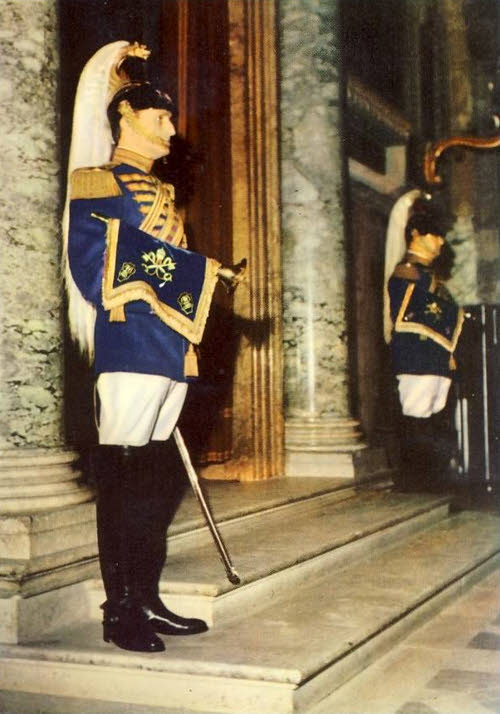
The esteem of Pius XII for hereditary nobility shines with particular brilliance in the following words addressed to the Pontifical Noble Guard on December 26, 1942:

None can be envious upon seeing that We bear you such special affection. To whom, in truth, is the immediate protection of Our person entrusted, if not to you? And are you not the first of Our guards?

Guard! What lofty resonance there is in this word: the soul trembles therewith; thoughts take wing. An ardent love for the sovereign and a steadfast reverence to his person and cause vibrate and voice themselves in this name; it sets in motion a tested generosity, an unvanquished constancy and courage in face of the risks met in his service and for his defense; it speaks of virtues which, molding the champion on the one hand, on the other hand evoke from the sovereign sentiments of esteem, affection, and confidence in his guard.

You, the guard of Our person, constitute Our armor, refulgent with that nobility which is the privilege of blood and which shone in you as the pledge of your devotion even before your admission into the Corps, for, as the ancient proverb says, "Good blood cannot lie." Life is the blood that is transmitted from rank to rank, from generation to generation in your illustrious lineages, carrying with it the fire of that devout love for the Church and the Roman Pontiff that neither diminishes nor cools with the changing events, be they joyous or sad. In the darkest hours of the history of the Popes, the loyalty of your ancestors shone brighter and burned more ardently and generously than in the resplendent hours of magnificence and material prosperity….We have no doubt that just as in the past so chosen a tradition of familiar virtues was transmitted from father to son, so will it continue to be transmitted from generation to generation as a patrimony of greatness of soul and most noble merit of one's respective stirp.19

7. Documents of Perennial Value

Lastly, some might object that after the death of Pius XII a new era began for the Church, that of the Second Vatican Council. Therefore, the allocutions of the deceased Pontiff to the Roman Patriciate and Nobility fell like dead leaves on the floor of the Church, and Conciliar and post-Conciliar Popes have not returned to the subject.

This is not true, either. As proof, this work will cite, argumentandi gratia, eloquent documents from the successors of the mourned Pontiff.20

We will now proceed to study the allocutions of Pius XII highlighting their magnificent doctrinal wealth. 

The "trombettieri" of the Pontifical Noble Guard

Footnotes:

(5) Cf. Plinio Corrêa de Oliveira, Revolution and Counter-Revolution (New Rochelle, N.Y.: The Foundation for a Christian Civilization, Inc., 1980), pp. 28-29, 61-70.

(6) See Chapter IV, 8, and Chapter V, 6.

(7) The Roman Patriciate is divided into: a) Roman Patricians, descended from those who held civil posts in the government of the pontifical city during the Middle Ages. b) Conscript Roman Patricians, who belong to any of the sixty Patrician families recognized as such by the Sovereign Pontiff in a special pontifical bull, which mentioned them by name. They constitute the cream of the Roman Patriciate. The Roman Nobility is also divided into two categories: a) Nobles descending from feudatories who had received a fief from the Sovereign Pontiff. b) Common nobles, whose nobility issued from the appointment to some court office, or directly from a pontifical concession.

(8) Two of Pius XII's allocutions to the Roman Patriciate and Nobility (those of 1952 and 1958) summarized the others. In 1944 Pius XII delivered a second allocution to the Roman Nobility on July 11 to thank their families for offering a generous sum of money to help the needy. Pius XII did not deliver any allocutions to the Roman Patriciate and Nobility between 1953 and 1957. He reestablished the custom with his allocution of January 1958, but died on October 9 of that year.

(9) See RPN 1943, Documents I.

(10) See Chapter IV, 3 and 7, and Chapter VI, 2 b.

(11) See Chapter V, 2.

(12) See Chapter III, 3 and 4. See also Appendix III of Nobility and Analogous Traditional Elites for important excerpts from pontifical documents that clarify the issue.

(13) Chapter I, 6.

(14) See Chapter IV, 8, and Chapter V, 6.

(15) The bibliography on this theme is vast. See especially: Joseph Cardinal Ratzinger, with Vittorio Messori, The Ratzinger Report (San Francisco: Ignatius Press, 1985), and Romano Amerio, Iota unum—Studio delle variazioni della Chiesa Cattolica nel secolo XX (Milan-Naples: Riccardo Ricciardi Editore, 1985). See also: Dietrich von Hildebrand, The Trojan Horse in the City of God and The Devastated Vineyard (Chicago: Franciscan Herald Press, 1967 and 1973, respectively); Rudolf Graber (Bishop of Regensburg), Athanasius and the Church of Our Time (Buckinghamshire: Van Duren C.P. Ltd., 1974); Cornelio Fabro, L'avventura della teologia progressista and La svolta antropologica di Karl Rahner (Milan: Rusconi Editore, both 1974); Anton Holzer, Vatikanum II: Reformkonzil oder Konstituante einer neuen Kirche (Basel: Saka, 1977); Wigand Siebel, Katholisch oder konziliar: Die Krise der Kirche heute (Munich-Vienna: Langen Müller, 1978); Joseph Cardinal Siri, Gethsemane: Reflections on the Current Theological Movement (Chicago: Franciscan Herald Press, 1981); Enrique Rueda, The Homosexual Network (Old Greenwich, Conn.: The Devin Adair Company, 1982); Georg May, Der Glaube in der nachkonziliaren Kirche (Vienna: Mediatrix Verlag, 1983); Richard Cowden-Guido, John Paul II and the Battle for Vatican II (Manassas, Va.: Trinity Communications, 1986).

(16) "The Church today is going through a moment of apprehension. Certain people are engaging in self-criticism, one might even say self-demolition. It is an acute and complex upheaval from within, which no one would have expected after the Council…. The Church is smitten even by those who belong to it" (Speech to the Pontifical Lombard Seminary, December 7, 1968, Insegnamenti di Paolo VI [Tipografia Poliglotta Vaticana, 1968], Vol. 6, p. 1188. Cf. L'Osservatore Romano [English weekly ed.], December 19, 1968, p. 3). "Referring to the situation of the Church of today, the Holy Father then affirmed that he had the feeling that `Satan's smoke has made its way into the temple of God through some crack'" (Homily "Resistite fortes in Fide" of June 29, 1972, L'Osservatore Romano [English weekly ed.], July 13, 1972, p. 6).

(17) RPN 1964, Insegnamenti di Paolo VI (Tipografia Poliglotta Vaticana, 1964), Vol. 2, p. 73.

(18) RPN 1958, p. 708.

(19) PNG 1942, pp. 349-350.

(20) See Chapter I, 6, and Chapter IV, 11.

Next

Table of Contents

Previous


Christmas 2023 - Puer natus est nobis!

>